Well, I am no more editing this blog.
This is to inform that documentation is available on
www.freewebs.com/ruchiraparihar/graffi-v.exe
which can be downloaded to understand the concept.
Friday, December 15, 2006

Friday, October 27, 2006
Exploration- User Testing Prototype 1
First level user testing involved two people,
one male and one female to test the working of the prototype
It was quite an interesting experience to watch them interact with the system
The video of prototype 1 is uploaded at www.freewebs.com/ruchiraparihar/proto_upload.htm
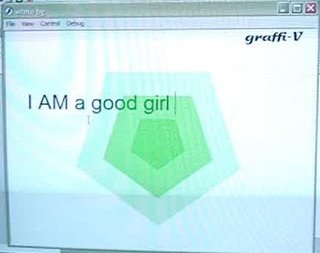
The videos of the user testing are uploaded at
www.freewebs.com/ruchiraparihar/proto_test1.htm
one male and one female to test the working of the prototype
It was quite an interesting experience to watch them interact with the system
The video of prototype 1 is uploaded at www.freewebs.com/ruchiraparihar/proto_upload.htm
www.freewebs.com/ruchiraparihar/proto_test1.htm
Exploration - White Paper ( Final Stage)
Well, the project white paper is turning out well, It was an experiment so as to find out what do people write ( as textual graffiti ) if given a chance to.
There were big white sheets being stuck in three computer laboratories where students work for almost 24 hours
The three laboratories differed in the following terms:
IT Lab had 24 students , 1 paper and no writing instrument provided
New MediaLab 8 Students, 1 paper and a sketch pen as a writing instrument provided
SUID Lab 5 Students , 1 paper and no writing instrument was provided
The project carried on for 4 days.
here are the images at
the first stage:
the intermediate stage:
the final stage:

The observations and deductions were:
For such a thing to take place, the instrument with which they write is a major factor which holds them from writing, i.e. if people don’t have a pen in their hand ( or in the vicinity ) they wont attempt to write even if they have something to write
The above point makes it clear that users would be happy to use voice as a tool to make graffiti because, they wont have to wait for an instrument to be in their hands, all they need is their voice.
Very few people take the initiative to be the first ones to write, i.e. the initialization should be done already for people to carry on the chain reaction.
Hence, the system of Graffi-V should be such that it initiates graffiti on its own and is exciting enough to invite people.It can do things like generating a random quote on its own, or start saying something like "who is it?" , and there can be people answering to the questions being put up and there will be graffiti in response to whatever they would say.
Usual scribbles on the white paper are often answering the one who has written before them.
It is interesting to note an answer back pattern.
Which gives an idea of a chat based interface, where two people talk and they create graffiti.
People use it as a messege board to leave messeges for all.
Hence the idea of a messege board, or a thought for the day board.
People crib a lot when given a chance to write on the paper, and when their identity is not revealed.I found obscene stuff on one of the whitepapers.
Hence there should be word filters if such a system is to made public.
Also , it can be used as a place to vent out one's frustrations.
I also found reminders on the whitepaper.
Hence it can be used as a reminder board.
It can also be used to save stories ( as in saving the memories for the others to scroll back and see )
I realized that the three labs were differing in their scenarios, it makes clear that the more the number of people involved , the more is the fun and more is the involvement in turn.
There were big white sheets being stuck in three computer laboratories where students work for almost 24 hours
The three laboratories differed in the following terms:
IT Lab had 24 students , 1 paper and no writing instrument provided
New MediaLab 8 Students, 1 paper and a sketch pen as a writing instrument provided
SUID Lab 5 Students , 1 paper and no writing instrument was provided
The project carried on for 4 days.
here are the images at
the first stage:
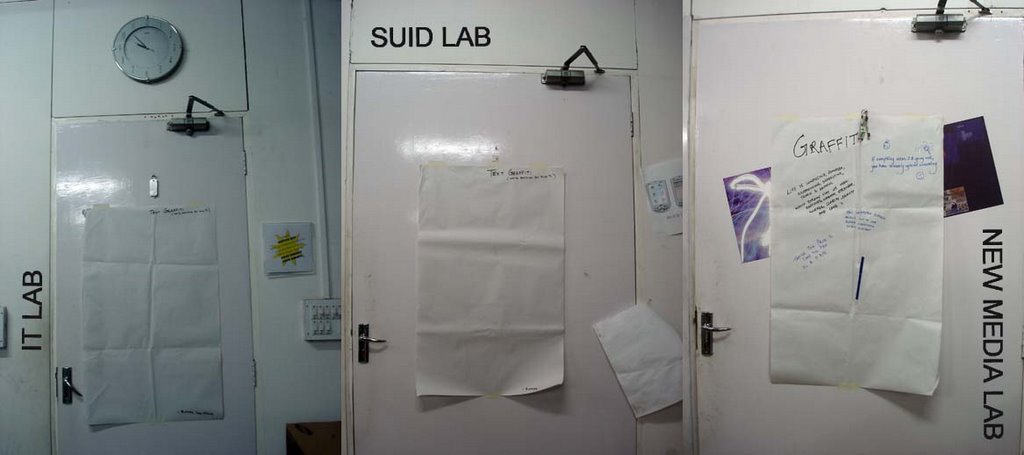
the intermediate stage:
the final stage:

The observations and deductions were:
For such a thing to take place, the instrument with which they write is a major factor which holds them from writing, i.e. if people don’t have a pen in their hand ( or in the vicinity ) they wont attempt to write even if they have something to write
The above point makes it clear that users would be happy to use voice as a tool to make graffiti because, they wont have to wait for an instrument to be in their hands, all they need is their voice.
Very few people take the initiative to be the first ones to write, i.e. the initialization should be done already for people to carry on the chain reaction.
Hence, the system of Graffi-V should be such that it initiates graffiti on its own and is exciting enough to invite people.It can do things like generating a random quote on its own, or start saying something like "who is it?" , and there can be people answering to the questions being put up and there will be graffiti in response to whatever they would say.
Usual scribbles on the white paper are often answering the one who has written before them.
It is interesting to note an answer back pattern.
Which gives an idea of a chat based interface, where two people talk and they create graffiti.
People use it as a messege board to leave messeges for all.
Hence the idea of a messege board, or a thought for the day board.
People crib a lot when given a chance to write on the paper, and when their identity is not revealed.I found obscene stuff on one of the whitepapers.
Hence there should be word filters if such a system is to made public.
Also , it can be used as a place to vent out one's frustrations.
I also found reminders on the whitepaper.
Hence it can be used as a reminder board.
It can also be used to save stories ( as in saving the memories for the others to scroll back and see )
I realized that the three labs were differing in their scenarios, it makes clear that the more the number of people involved , the more is the fun and more is the involvement in turn.
Research- Human Factors in Speech
Human factors in speech
?>?>?>?>
For many years a group of human factors specialists have studied the implications of speech technology on human computer interaction.
In addition to physiological aspects of human factors, there are the cognitive and psychological aspects of human interacting with speech technology in computers .for example what constraints must users observe in their speech so that a speech recognizer can understand them?
Does constraining their speech make them more or less effective? Does it change the way they work? How do people react to synthesized speech? Do they mind if the computer sounds like a computer? Do they prefer that it sound like a human? How does computer speech affect task performance? Now add this to the aspect of Multi-Modality. Some speech technology involves speech only, but a significant portion of the interfaces being designed with speech are multi-modal. They involve not just speech, but other modes such as tactile or visual. For example a desktop dictation system involves speaking to the computer and possibly using the mouse and keyboard to make corrections. Speech added to a personal digital assistant handheld device means that people will be speaking while looking at a small screen while pushing buttons. Research is looking at when people use which modes and how they use them together.
Here, then are some of the human factors issues surrounding speech technology.
High error rates
Neural network technology dramatically improves speech recognition systems and allows speech recognizers to hear human speech even better than humans do, especially when competing with background noise.
Much work has to be done to help humans to detect errors and to devise and carry out error strategies. Imagine if every tenth key press you made on your keyboard resulted in the wrong letter appearing on the screen. This would affect your typing and your performance significantly. That describes the state of errors with speech recognition for many systems.
Unpredictable errors
Besides relatively high error rates, the errors that speech systems make are not necessarily logical or predictable from the human’s point of view. Although some are more understandable- such as hearing ?>?>?>?>
When we speak to a computer we don to appreciate the effect that such qualities as intonation, pitch, volume, and background noise can have. We think we have spoken clearly but we may actually be sending and ambiguous signal. The computer may understand a phrase one time and misunderstand the same phrase another time. Users do not like using un-predictable systems lower interims of acceptance and satisfaction of speech technology
People’s expectations
Humans have high expectations of computers and speech. When they are told that a computer has speech technology built in they often expect that they will have a natural conversation with it. They expect the computer to understand them and they expect to understand the computer. If this human-like conversational expectation is not met (and it is often not met), then they grow frustrated and unwilling to talk to the computer on its realistic terms.
However if humans are given realistic expectations of what the computer can and cant understand .then the are comfortable constraining their speech to certain phrases and commands. This does not seem to impede performance on task. Using constrained speech is not a natural way for people talk to pother people or even a natural way for people to talk to computers .nevertheless, within short time users can learn and adapt well to constrained speech.
Users prefer constrained speech that works to conversational speech those results in errors.
Working multi-modally
Many tasks lend themselves to multi modality for example a traveler may point to two locations on a map saying “how far?”... People will use one modality such as speech alone followed by other another modality such as pointing with a mouse or pen. In other words they will switch between modes. Sometimes they use two or more modes simultaneously or nearly so for example pointing first and then talking.
Speech only systems tax memory
Because a speech only system lacks visual feedback or confirmation, it is taxing on human memory. Long menus in telephony applications for instance are hard to remember
Spoken language is different
People speak differently than they write, and they expect systems that speak to them to use different terminology than what they may read. For example, people can understand terms such as delete or cancel when viewing them as button labels on a GUI screen but they expect to hear a less formal language when they listen to a computer speak
Users are not aware of their speech habits. Many characteristics of human speech are difficult for computers to understand, for example using “ums” or “uhs” in sentences or talking too fast or too softly .Many of these characteristics are unconscious habits.
People Model Speech
Luckily people will easily model another’s speech without realizing it. We can constrain or affect the user’s speech by having the computer speak the way you want the user to speak. People tend to imitate what they hear!
This is taken from the book "Designing Effective Speech Interfaces" by Susan Weinschenk and Dean T Barker
Research- Types of interfaces
We are concerned with how to design products so that people can be productive as possible with the product, as quickly as possible. Designing to optimize usability means paying specific attention to how the interface looks and acts
This includes
¨ Ensuring that the interface matches the way people need or want to accomplish a task
¨ Using the appropriate modality for example visual or voice at appropriate time
¨ Spending adequate design time on the interface
What are the types of interfaces?
There are several types of interfaces.in the past and still around to some extent were character based user interfaces then graphical user interfaces became prevlent and next came web user interfaces WUI and then speech user interfaces
What is speech interface?
It would be simple to answer but it is not
Because it is a relatively new idea to have our technology involve speech. This is a field that is just starting to grow. Like any new field, the definitions and terminologies are not standard
Speech interfaces
The term speech interface describes a software interface that employs wither human speech or simulated human speech. You can further break down interfaces into auditory user interfaces and graphical user interfaces with speech.
Auditory user interfaces AUI
An auditory user interface is an interface which relies primarily or exclusively on audio for interaction including speech and sounds. This means that commands issued by the machine or computer as well as all commands issued by the human to control the machine or computer are executed primarily with speech and sounds. Although AUI may include a hardware component such as a key pad or buttons visual displays are not used for critical information
Examples are
¨ Medical transcription software that allows doctors to dictate medical notes while making rounds
¨ Automobile hands free systems that allow drivers to access travel information and directions
¨ Interactive voice response systems in which users access information by speaking commands such as menu numbers to listen to information of their choice
¨ Products for the visually impaired that rely only on audio text and cues
Graphical user interfaces with speech
AUI where the user interacts with the software primarily via speech.we call these multi-modal interfaces ie graphical user interfaces with speech or S/GUI for speech/GUI
¨ A word processor that allows users to dictate text instead of or in addition to typing it in
¨ Web navigation software that allows users to navigate to and within websites by using voice
¨ Talking dictionaries that speak definitions
In these S/GUI applications, tasks can
¨ Be completed using speech only where users issue a speech command or listen to the software speak to the software speak to them
¨ Rely on visual or manual gui aspects for example viewing a graphic or clicking a hyperlink
¨ Require or at least allow a combination of both a GUI
Non-speech audio
Some interface elements include audio but not speech these interface elements include music and sounds.some non speech audio is included in almost all interfaces of any type including S/GUI , AUI,and GUIs .examples of non speech audio include
¨ The computer beeps when the user makes an error
¨ The user clicks on a map and hears a low tone to indicate that the water to be foudna t that site is deep in the ground or a high tone to indicate that the water is closer to the surface
This is taken from the book "Designing Effective Speech Interfaces" by Susan Weinschenk and Dean T Barker
Thursday, October 26, 2006
Prototype- First Prototype
Ok, the first prototype is finally coded and is ready.
I am uploading a video at
www.freewebs.com/ruchiraparihar/proto_upload.htm
Wednesday, October 25, 2006
Thought Process - Frustration
It frustrates when the code doesnt work the way you want it to.
Trying to visualize speech in some way.. and what the code is doing is not the way I want it to look on the screen.
Spent my day revising Visual Basic so that to incorporate Microsoft's speech recognition in it and to be able to save files real time..
The book I am reading is Mastering VB 6, what I have on my system is Visual Studio 2005, this so called upgraded version lacks in upward compatibility of the look and feel or atleast the terminology of the older version.Finding it really difficult to work for me.
Tried uninstalling VS2005, and tried installing VB 6, it did not happen because the system was able to find a dll which was of a higher version and hence could not be re-written and hence the set up was aborted.
So I installed Visual Studio 2005 again to work.. and now, Microsoft Office is having some problem with VS 2005, every time I try to open any Microsoft Office Application, it tries to install some of the missing components ( God Only Knows, where they went ) and the application either starts after a long delay or crashes.
So, this explains, that even if you have everything in your mind-all concepts ready-you are late or unable to implement- because the world is SOFT..
But in the end we are all dependent on softwares..
Trying to visualize speech in some way.. and what the code is doing is not the way I want it to look on the screen.
Spent my day revising Visual Basic so that to incorporate Microsoft's speech recognition in it and to be able to save files real time..
The book I am reading is Mastering VB 6, what I have on my system is Visual Studio 2005, this so called upgraded version lacks in upward compatibility of the look and feel or atleast the terminology of the older version.Finding it really difficult to work for me.
Tried uninstalling VS2005, and tried installing VB 6, it did not happen because the system was able to find a dll which was of a higher version and hence could not be re-written and hence the set up was aborted.
So I installed Visual Studio 2005 again to work.. and now, Microsoft Office is having some problem with VS 2005, every time I try to open any Microsoft Office Application, it tries to install some of the missing components ( God Only Knows, where they went ) and the application either starts after a long delay or crashes.
So, this explains, that even if you have everything in your mind-all concepts ready-you are late or unable to implement- because the world is SOFT..
But in the end we are all dependent on softwares..
Tuesday, October 24, 2006
Explorations- Echo
Coding: Microphone properties in Flash 8
Microphone
public class Microphone
extends Object
The Microphone class lets you capture audio from a microphone attached to the computer that is running Flash Player.
The Microphone class is primarily for use with Flash Communication Server but can be used in a limited fashion without the server, for example, to transmit sound from your microphone through the speakers on your local system.
Caution: Flash Player displays a Privacy dialog box that lets the user choose whether to allow or deny access to the microphone. Make sure your Stage size is at least 215 x 138 pixels; this is the minimum size Flash requires to display the dialog box.
Users and Administrative users may also disable microphone access on a per-site or global basis.
To create or reference a Microphone object, use the Microphone.get() method.
Availability: ActionScript 1.0; Flash Player 6
Property summary
activityLevel:Number [read-only]
A numeric value that specifies the amount of sound the microphone is detecting.
gain:Number [read-only]
The amount by which the microphone boosts the signal.
index:Number [read-only]
A zero-based integer that specifies the index of the microphone, as reflected in the array returned by Microphone.names.
muted:Boolean [read-only]
A Boolean value that specifies whether the user has denied access to the microphone (true) or allowed access (false).
name:String [read-only]
A string that specifies the name of the current sound capture device, as returned by the sound capture hardware.
static
names:Array [read-only]
Retrieves an array of strings reflecting the names of all available sound capture devices without displaying the Flash Player Privacy Settings panel.
rate:Number [read-only]
The rate at which the microphone is capturing sound, in kHz.
silenceLevel:Number [read-only]
An integer that specifies the amount of sound required to activate the microphone and invoke Microphone.onActivity(true).
silenceTimeOut:Number [read-only]
A numeric value representing the number of milliseconds between the time the microphone stops detecting sound and the time Microphone.onActivity(false) is invoked.
useEchoSuppression:Boolean [read-only]
Property (read-only); a Boolean value of true if echo suppression is enabled, false otherwise.
Event summary
Event
Description
onActivity = function(active:Boolean) {}
Invoked when the microphone starts or stops detecting sound.
onStatus = function(infoObject:Object) {}
Invoked when the user allows or denies access to the microphone.
Method summary
Modifiers
Signature
Description
static
get([index:Number]) : Microphone
Returns a reference to a Microphone object for capturing audio.
setGain(gain:Number) : Void
Sets the microphone gain--that is, the amount by which the microphone should multiply the signal before transmitting it.
setRate(rate:Number) : Void
Sets the rate, in kHz, at which the microphone should capture sound.
setSilenceLevel(silenceLevel:Number, [timeOut:Number]) : Void
Sets the minimum input level that should be considered sound and (optionally) the amount of silent time signifying that silence has actually begun.
setUseEchoSuppression(useEchoSuppression:Boolean) : Void
Specifies whether to use the echo suppression feature of the audio codec.
Methods inherited from class Object
-------
This makes it clear that if I use Flash Professional 8 for coding, i would be able to make use of the following properties of sound:
activityLevel, gain index,muted,name, rate and silenceLevel .
public class Microphone
extends Object
The Microphone class lets you capture audio from a microphone attached to the computer that is running Flash Player.
The Microphone class is primarily for use with Flash Communication Server but can be used in a limited fashion without the server, for example, to transmit sound from your microphone through the speakers on your local system.
Caution: Flash Player displays a Privacy dialog box that lets the user choose whether to allow or deny access to the microphone. Make sure your Stage size is at least 215 x 138 pixels; this is the minimum size Flash requires to display the dialog box.
Users and Administrative users may also disable microphone access on a per-site or global basis.
To create or reference a Microphone object, use the Microphone.get() method.
Availability: ActionScript 1.0; Flash Player 6
Property summary
activityLevel:Number [read-only]
A numeric value that specifies the amount of sound the microphone is detecting.
gain:Number [read-only]
The amount by which the microphone boosts the signal.
index:Number [read-only]
A zero-based integer that specifies the index of the microphone, as reflected in the array returned by Microphone.names.
muted:Boolean [read-only]
A Boolean value that specifies whether the user has denied access to the microphone (true) or allowed access (false).
name:String [read-only]
A string that specifies the name of the current sound capture device, as returned by the sound capture hardware.
static
names:Array [read-only]
Retrieves an array of strings reflecting the names of all available sound capture devices without displaying the Flash Player Privacy Settings panel.
rate:Number [read-only]
The rate at which the microphone is capturing sound, in kHz.
silenceLevel:Number [read-only]
An integer that specifies the amount of sound required to activate the microphone and invoke Microphone.onActivity(true).
silenceTimeOut:Number [read-only]
A numeric value representing the number of milliseconds between the time the microphone stops detecting sound and the time Microphone.onActivity(false) is invoked.
useEchoSuppression:Boolean [read-only]
Property (read-only); a Boolean value of true if echo suppression is enabled, false otherwise.
Event summary
Event
Description
onActivity = function(active:Boolean) {}
Invoked when the microphone starts or stops detecting sound.
onStatus = function(infoObject:Object) {}
Invoked when the user allows or denies access to the microphone.
Method summary
Modifiers
Signature
Description
static
get([index:Number]) : Microphone
Returns a reference to a Microphone object for capturing audio.
setGain(gain:Number) : Void
Sets the microphone gain--that is, the amount by which the microphone should multiply the signal before transmitting it.
setRate(rate:Number) : Void
Sets the rate, in kHz, at which the microphone should capture sound.
setSilenceLevel(silenceLevel:Number, [timeOut:Number]) : Void
Sets the minimum input level that should be considered sound and (optionally) the amount of silent time signifying that silence has actually begun.
setUseEchoSuppression(useEchoSuppression:Boolean) : Void
Specifies whether to use the echo suppression feature of the audio codec.
Methods inherited from class Object
-------
This makes it clear that if I use Flash Professional 8 for coding, i would be able to make use of the following properties of sound:
activityLevel, gain index,muted,name, rate and silenceLevel .
Monday, October 23, 2006
Thought Process - Intermediate state
Right nowI am trying my hand on coding and basically trying and building up a prototype which will take audio input, separate it into its various parameters and map its corresponding values to text attributes.
I have been able to speech to text conversion. but have not been able to integrate it with some interface so that its output can be used as input
The project "white paper" is continuing.
At the same time I am trying to work on a script which would let people do graffiti online and save it.
I have been able to speech to text conversion. but have not been able to integrate it with some interface so that its output can be used as input
The project "white paper" is continuing.
At the same time I am trying to work on a script which would let people do graffiti online and save it.
Friday, October 20, 2006
Explorations - White Paper
The Project “White Paper”
The project “White Paper” is a part of the analytical study through implementation and experimentation for my classroom project “graffi-V”
The project is about collaboratively doing graffiti art on a big display by giving voice inputs. Whatever a person speaks, is broken down into different parameters of sound, i.e. frequency, loudness etc, and all these parameters are mapped to the different properties of the text ( which is speech to text converted from whatever the person has spoken ) like colour, font, font size etc. It is a project about sociability where people come together to collaboratively do graffiti on a display screen.
As a part of this project and to understand people’s behavior, I stuck three large white sheets in 3 Computer Laboratories of the campus. And left it with them in their labs for 3 days and allowed them to write their mind on them.
The initial observations are:
For such a thing to take place, the instrument with which they write is a major factor which holds them from writing, i.e. if people don’t have a pen in their hand ( or in the vicinity ) they wont attempt to write even if they have something to write
Very few people take the initiative to be the first ones to write, i.e. the initialization should be done already for people to carry on the chain reaction.
Usual scribbles on the white paper are often answering the one who has written before them.
This makes me think, if graffi-V should be a “one at a time” input system.
I will write down other observations as the days will pass by
The project “White Paper” is a part of the analytical study through implementation and experimentation for my classroom project “graffi-V”
The project is about collaboratively doing graffiti art on a big display by giving voice inputs. Whatever a person speaks, is broken down into different parameters of sound, i.e. frequency, loudness etc, and all these parameters are mapped to the different properties of the text ( which is speech to text converted from whatever the person has spoken ) like colour, font, font size etc. It is a project about sociability where people come together to collaboratively do graffiti on a display screen.
As a part of this project and to understand people’s behavior, I stuck three large white sheets in 3 Computer Laboratories of the campus. And left it with them in their labs for 3 days and allowed them to write their mind on them.
The initial observations are:
For such a thing to take place, the instrument with which they write is a major factor which holds them from writing, i.e. if people don’t have a pen in their hand ( or in the vicinity ) they wont attempt to write even if they have something to write
Very few people take the initiative to be the first ones to write, i.e. the initialization should be done already for people to carry on the chain reaction.
Usual scribbles on the white paper are often answering the one who has written before them.
This makes me think, if graffi-V should be a “one at a time” input system.
I will write down other observations as the days will pass by
Wednesday, October 18, 2006
Scenario
This is section covers scenarios,you need to understand the concept, in order to understand the scenarios:
I will include scenarios both during ideation and after conceptualization.
Scenarios during ideation are:

This was an intial scenario where what you sing is visualized.
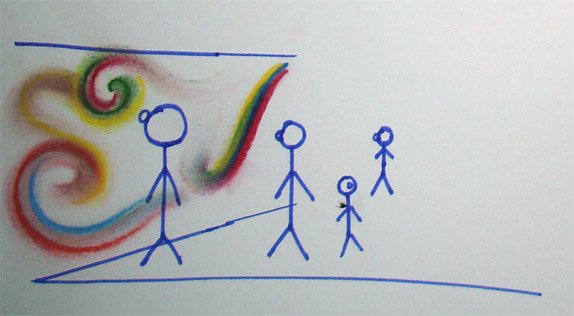
Then came the idea of drawing with sound.
Concept
Project Description
Graffi-V is experiential graffiti for creators and audience. A system enables the creators to create graffiti real time with whatever they are speaking.
Graffiti has been recognized as a powerful yet subtle form of expression. Collaborative Graffiti fulfills participants’ satisfaction on both desires for creation and social interaction. It lets them vent their emotions and also to leave a trail of memory behind.
The graffi-V creators will be able to create forms by merely speaking, and whatever they will be speaking will be displayed on the screen(text and form) according to the way they speak
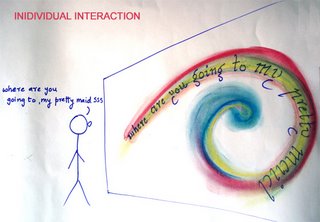
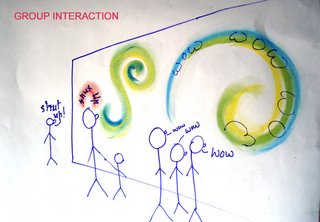
Environmental Requirements:
System Requirements:
Implementation
Why Graffi-“V”
Graffi-V, V as Vocal,Visual and V as in We i.e. collaborative
It gives people a sense of connectedness with the environment.
Taking it forward..
It would be very nice if the audience would be able to hear how a particular line was spoken ..
if there is an inverse of this application which converts the patterns and text to voice,it would be great
Scenarios are covered in a later section.
Graffi-V is experiential graffiti for creators and audience. A system enables the creators to create graffiti real time with whatever they are speaking.
Graffiti has been recognized as a powerful yet subtle form of expression. Collaborative Graffiti fulfills participants’ satisfaction on both desires for creation and social interaction. It lets them vent their emotions and also to leave a trail of memory behind.
The graffi-V creators will be able to create forms by merely speaking, and whatever they will be speaking will be displayed on the screen(text and form) according to the way they speak
Environmental Requirements:
- An otherwise silent place, where saying something "aloud" is "allowed"
- People
System Requirements:
- Microphone
- Display Screen
- Microsoft speech recognition engine
Implementation
- Cascaded style sheets
- xml
- Visual basic
- Flash 8 professional
Why Graffi-“V”
Graffi-V, V as Vocal,Visual and V as in We i.e. collaborative
It gives people a sense of connectedness with the environment.
Taking it forward..
It would be very nice if the audience would be able to hear how a particular line was spoken ..
if there is an inverse of this application which converts the patterns and text to voice,it would be great
Scenarios are covered in a later section.
Thought Process
This is a section about the thoughts and the process followed:
Frustration of coding
Intermediate state
Graffiti :a thought
Properties of sound
Voice Recognition
Speech recongition on my system
Action and Reaction
Frustration of coding
Intermediate state
Graffiti :a thought
Properties of sound
Voice Recognition
Speech recongition on my system
Action and Reaction
Research
Research- Human Factors in Speech
Research- Types of interfaces
Research - City Space
Graffiti as collaborative art
All about graffiti
Digital sound modelling
Experiments with some properties of sound
Robo responding to voice commands
Voice based Gaming
A Sound frequency dependent blender XP
Voice Input in Windows XP
Interactive Mirror
Wooden Mirror
Research- Types of interfaces
Research - City Space
Graffiti as collaborative art
All about graffiti
Digital sound modelling
Experiments with some properties of sound
Robo responding to voice commands
Voice based Gaming
A Sound frequency dependent blender XP
Voice Input in Windows XP
Interactive Mirror
Wooden Mirror
Tuesday, October 17, 2006
Coding: Macromedia Communication Server 1.5
Flash Communication Server MX 1.5 At a Glance
Uniting Communications and Applications
Develop the next generation of online communications: Deliver multi-way audio, video, and real-time data in your websites and Rich Internet Applications. Create engaging pre-sales applications that integrate audio, video, text, chat, and enterprise data. Develop powerful corporate presentations with streaming video and synchronized multimedia content that are deployed seamlessly within the context and branding of your site. Or build collaborative meeting applications that bring people together in real-time-connecting them to each other, to live data sources, and to back-end services for a significantly more compelling online experience.
* Powerful
* Easy
* Open
Powerful
Create and deploy powerful new communications functionality within your Internet applications-all delivered through the ubiquitous Macromedia Flash Player.
Add interactive functionality, including video and data broadcasts, shared whiteboards, virtual conference rooms, message boards, polling, live chat, messaging, and much more.
Deliver engaging real-time streamed media. Synchronize video streams with multimedia material to provide powerful supporting content for presentations. Use server scripting to control streams and program broadcasts to exact specifications. Provide end users with the best possible experience through a seamlessly integrated client that lets you brand your broadcast the way you want.
Tap into multi-way, multi-user communications for rich media messaging. Create and deploy rich media messaging features such as live video, audio or text-based messaging, chat, polling, and more. Support for both real-time and recorded messages makes a powerful base for developing compelling Internet communications.
Offer real-time collaboration. With team message boards, shared whiteboards, online conference rooms, and more, it's now easy for multiple connected users to share data and user interfaces in real-time. Create robust applications that can be used offline and synchronized automatically when the user returns online.
Easy
Rapidly develop rich communications applications with a highly integrated set of authoring, debugging, and administration tools.
Ensure the broadest reach for your work by deploying to the highly integrated and widely distributed Macromedia Flash Player. With Macromedia Flash Player, playback is consistent and reliable across browsers, platforms, and devices. Now you can deliver a completely customized experience with no unwanted offers, advertisements, outside branding, or new browsers launching to carry visitors away from your site.
Develop rich communications easily by leveraging existing skills and toolsets with the highly integrated Macromedia Studio MX. Easily add communications functionality within the Macromedia Flash MX authoring environment, using standards-based ActionScript. Take advantage of server-side ActionScript development in Macromedia Dreamweaver MX.
Take advantage of pre-built components to add streaming video, live chat, meeting rooms, instant messaging, and more to applications. It's as quick-and easy-as dragging and dropping communications features into place with Macromedia Flash MX. Use the library of components available for Macromedia Flash Communication Server MX, or build your own reusable components in the Macromedia Flash MX authoring environment.
Customize your communications solutions in a flexible, server-scripting environment that makes it easy to build communications solutions to meet specific project requirements.
Open
Macromedia Flash Communication Server MX works with major existing platforms on the client and server, so you can enhance and leverage your existing investments.
Integrate seamlessly with application servers. Use built-in support for Flash Remoting to connect to application servers, databases, XML web services, and directory services, enabling integration with existing applications and data-and providing real-time data for customers. Flash Remoting is native in Macromedia ColdFusion and JRun and available separately for .NET and J2EE.
Provide a simpler experience for your users. Macromedia Flash Player automatically recognizes installed microphones and standard USB or Firewire cameras, so your users can begin communicating immediately-without performing complex installations or configurations.
Rely on a familiar scripting model. Create compelling applications with just a few lines of code. Use standard JavaScript scripting language (ECMA-262) to build application logic on the server.
Uniting Communications and Applications
Develop the next generation of online communications: Deliver multi-way audio, video, and real-time data in your websites and Rich Internet Applications. Create engaging pre-sales applications that integrate audio, video, text, chat, and enterprise data. Develop powerful corporate presentations with streaming video and synchronized multimedia content that are deployed seamlessly within the context and branding of your site. Or build collaborative meeting applications that bring people together in real-time-connecting them to each other, to live data sources, and to back-end services for a significantly more compelling online experience.
* Powerful
* Easy
* Open
Powerful
Create and deploy powerful new communications functionality within your Internet applications-all delivered through the ubiquitous Macromedia Flash Player.
Add interactive functionality, including video and data broadcasts, shared whiteboards, virtual conference rooms, message boards, polling, live chat, messaging, and much more.
Deliver engaging real-time streamed media. Synchronize video streams with multimedia material to provide powerful supporting content for presentations. Use server scripting to control streams and program broadcasts to exact specifications. Provide end users with the best possible experience through a seamlessly integrated client that lets you brand your broadcast the way you want.
Tap into multi-way, multi-user communications for rich media messaging. Create and deploy rich media messaging features such as live video, audio or text-based messaging, chat, polling, and more. Support for both real-time and recorded messages makes a powerful base for developing compelling Internet communications.
Offer real-time collaboration. With team message boards, shared whiteboards, online conference rooms, and more, it's now easy for multiple connected users to share data and user interfaces in real-time. Create robust applications that can be used offline and synchronized automatically when the user returns online.
Easy
Rapidly develop rich communications applications with a highly integrated set of authoring, debugging, and administration tools.
Ensure the broadest reach for your work by deploying to the highly integrated and widely distributed Macromedia Flash Player. With Macromedia Flash Player, playback is consistent and reliable across browsers, platforms, and devices. Now you can deliver a completely customized experience with no unwanted offers, advertisements, outside branding, or new browsers launching to carry visitors away from your site.
Develop rich communications easily by leveraging existing skills and toolsets with the highly integrated Macromedia Studio MX. Easily add communications functionality within the Macromedia Flash MX authoring environment, using standards-based ActionScript. Take advantage of server-side ActionScript development in Macromedia Dreamweaver MX.
Take advantage of pre-built components to add streaming video, live chat, meeting rooms, instant messaging, and more to applications. It's as quick-and easy-as dragging and dropping communications features into place with Macromedia Flash MX. Use the library of components available for Macromedia Flash Communication Server MX, or build your own reusable components in the Macromedia Flash MX authoring environment.
Customize your communications solutions in a flexible, server-scripting environment that makes it easy to build communications solutions to meet specific project requirements.
Open
Macromedia Flash Communication Server MX works with major existing platforms on the client and server, so you can enhance and leverage your existing investments.
Integrate seamlessly with application servers. Use built-in support for Flash Remoting to connect to application servers, databases, XML web services, and directory services, enabling integration with existing applications and data-and providing real-time data for customers. Flash Remoting is native in Macromedia ColdFusion and JRun and available separately for .NET and J2EE.
Provide a simpler experience for your users. Macromedia Flash Player automatically recognizes installed microphones and standard USB or Firewire cameras, so your users can begin communicating immediately-without performing complex installations or configurations.
Rely on a familiar scripting model. Create compelling applications with just a few lines of code. Use standard JavaScript scripting language (ECMA-262) to build application logic on the server.
Research - City Space
A part of the paper about the movie "City Space" which was t a candid documentary exposing the conflicts and contradictions surrounding graffiti in Vancouver
Director: Craig Noble
It is tried to uncover a world where the line between art and vandalism is blurred.creative expression and social responsiblity meet head on in an articulate collage of fact and opinion as subculture and bureaucracy collide.
the paper is worth reading, it changes one's perspective towards art and vandalism..
Director: Craig Noble
It is tried to uncover a world where the line between art and vandalism is blurred.creative expression and social responsiblity meet head on in an articulate collage of fact and opinion as subculture and bureaucracy collide.
the paper is worth reading, it changes one's perspective towards art and vandalism..
Saturday, October 14, 2006
Research-Collaborative art
Common Weal Community Arts engages communities and professional artists to come together and create art.
It's all about finding social empowerment through the spirit of collaboration. The process of working together helps the participants build bridges to each other, and leads to the creation of high-calibre art.
Common Weal inspires ideas for social change through art. By linking professional artists with communities to engage in collaborative art projects, we empower people - and their communities - to tell their stories in their own voices.
Research- WIFI Graffiti ( Wiffiti )
http://www.wiffiti.com/txtoutloud/
A new technology called Wiffiti is,enabling people to send text messages to large flat panel displays in social venues such as cafes, bars and clubs. Wiffiti is grounded upon the premise that sending messages to a public screen rather than a private phone will resonate with both the location and its community.

Messages sent to Wiffiti screens are also visible on this web site, encouraging people to watch “the word on the street” as it unfolds. Click on the viewer tab, pick a screen, and send a txt from anywhere. Then, sit back and watch responses appear from across the country! Better yet, head over to the closest Wiffiti location to txt out loud!
The first Wiffiti screen was installed in January 2006 at Someday Café in Boston, MA, a city that now has three other Wiffiti screens. Screens are now spreading rapidly, appearing in Chicago, Denver, Seattle, Knoxville, Boulder and New York.
I tried getting a password and also tried to log in, but it does not work for international audience.
It's all about finding social empowerment through the spirit of collaboration. The process of working together helps the participants build bridges to each other, and leads to the creation of high-calibre art.
Common Weal inspires ideas for social change through art. By linking professional artists with communities to engage in collaborative art projects, we empower people - and their communities - to tell their stories in their own voices.
Research- WIFI Graffiti ( Wiffiti )
http://www.wiffiti.com/txtoutloud/
A new technology called Wiffiti is,enabling people to send text messages to large flat panel displays in social venues such as cafes, bars and clubs. Wiffiti is grounded upon the premise that sending messages to a public screen rather than a private phone will resonate with both the location and its community.

Messages sent to Wiffiti screens are also visible on this web site, encouraging people to watch “the word on the street” as it unfolds. Click on the viewer tab, pick a screen, and send a txt from anywhere. Then, sit back and watch responses appear from across the country! Better yet, head over to the closest Wiffiti location to txt out loud!
The first Wiffiti screen was installed in January 2006 at Someday Café in Boston, MA, a city that now has three other Wiffiti screens. Screens are now spreading rapidly, appearing in Chicago, Denver, Seattle, Knoxville, Boulder and New York.
I tried getting a password and also tried to log in, but it does not work for international audience.
Thursday, October 12, 2006
Research- Graffiti
History of Graffiti
The word "graffiti" derives from the Greek word graphein meaning: to write. This evolved into the Latin word graffito. Graffiti is the plural form of graffito. Simply put, graffiti is a drawing, scribbling or writing on a flat surface. Today, we equate graffiti with the "New York" or "Hip Hop" style which emerged from New York City in the 1970's.
Graffiti Culture
Graffiti quickly became a social scene. Friends often form crews of vandals. One early crew wrote TAG as their crew name, an acronym for Tuff Artists Group. Tag has since come to mean both graffiti writing, 'tagging' and graffiti, a 'tag'. Crews often tag together, writing both the crew tag and their own personal tags. Graffiti has its own language with terms such as: piece, toy, wild-style, and racking.
Graffiti Tools
At first pens and markers were used, but these were limited as to what types of surfaces they worked on so very quickly everyone was using spray paint. Spray paint could mark all types of surfaces and was quick and easy to use. The spray nozzles on the spray cans proved inadequate to create the more colorful pieces. Caps from deodorant, insecticide, WD-40 and other aerosol cans were substituted to allow for a finer or thicker stream of paint. As municipalities began passing graffiti ordinances outlawing graffiti implements, clever ways of disguising paint implements were devised. Shoe polish, deodorant roll-ons and other seemingly innocent containers are emptied and filled with paint. Markers, art pens and grease pens obtained from art supply stores are also used. In fact nearly any object which can leave a mark on most surfaces are used by taggers, though the spray can is the medium of choice for most taggers.
Graffiti in the 21st Century
As graffiti has grown, so too has its character. What began as an urban lower-income protest, nationally, graffiti now spans all racial and economic groups. While many inner-city kids are still heavily involved in the graffiti culture, one tagger recently caught in Philadelphia was a 27 year old stockbroker who drove to tagging sites in his BMW. Styles have dramatically evolved from the simple cursory style, which is still the most prevalent, to intricate interlocking letter graphic designs with multiple colors called pieces (from masterpieces).
Graffiti Style Art
While most taggers are simply interested in seeing their name in as many places as possible and as visibly as possible, some taggers are more contented to find secluded warehouse walls where they can practice their pieces. Some of these taggers are able to sell twelve foot canvases of their work for upwards of 10 - 12 thousand dollars.
Commercialization, the Web and the World
Graffiti shops, both retail and on-line, sell a wide variety of items to taggers. Caps, markers, magazines, T-shirts, backpacks, shorts with hidden pockets, even drawing books with templates of different railroad cars can be purchased. Over 25,000 graffiti sites exist on the world wide web, the majority of these are pro-graffiti. Graffiti vandalism is a problem in nearly every urban area in the world. Pro-graffiti web sites post photos of graffiti from Europe, South America, the Philippines, Australia, South Africa, China and Japan. Billions of dollars worldwide are spent each year in an effort to curb graffiti
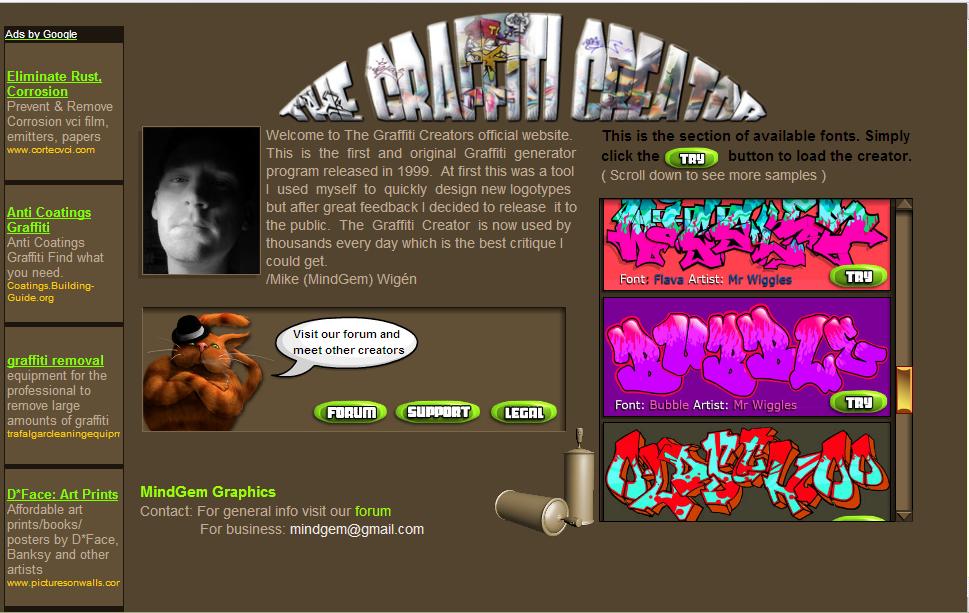
one such site i found was,a graffiti creator http://www.graffiticreator.net/ where you can (online) create text images like graffiti
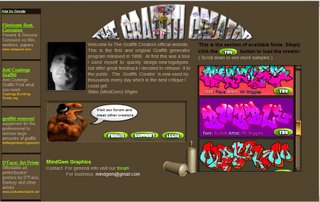
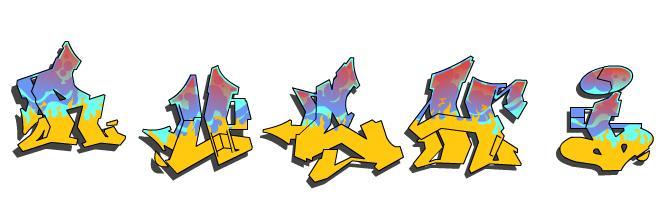
tried writing my name:

The word "graffiti" derives from the Greek word graphein meaning: to write. This evolved into the Latin word graffito. Graffiti is the plural form of graffito. Simply put, graffiti is a drawing, scribbling or writing on a flat surface. Today, we equate graffiti with the "New York" or "Hip Hop" style which emerged from New York City in the 1970's.
Graffiti Culture
Graffiti quickly became a social scene. Friends often form crews of vandals. One early crew wrote TAG as their crew name, an acronym for Tuff Artists Group. Tag has since come to mean both graffiti writing, 'tagging' and graffiti, a 'tag'. Crews often tag together, writing both the crew tag and their own personal tags. Graffiti has its own language with terms such as: piece, toy, wild-style, and racking.
Graffiti Tools
At first pens and markers were used, but these were limited as to what types of surfaces they worked on so very quickly everyone was using spray paint. Spray paint could mark all types of surfaces and was quick and easy to use. The spray nozzles on the spray cans proved inadequate to create the more colorful pieces. Caps from deodorant, insecticide, WD-40 and other aerosol cans were substituted to allow for a finer or thicker stream of paint. As municipalities began passing graffiti ordinances outlawing graffiti implements, clever ways of disguising paint implements were devised. Shoe polish, deodorant roll-ons and other seemingly innocent containers are emptied and filled with paint. Markers, art pens and grease pens obtained from art supply stores are also used. In fact nearly any object which can leave a mark on most surfaces are used by taggers, though the spray can is the medium of choice for most taggers.
Graffiti in the 21st Century
As graffiti has grown, so too has its character. What began as an urban lower-income protest, nationally, graffiti now spans all racial and economic groups. While many inner-city kids are still heavily involved in the graffiti culture, one tagger recently caught in Philadelphia was a 27 year old stockbroker who drove to tagging sites in his BMW. Styles have dramatically evolved from the simple cursory style, which is still the most prevalent, to intricate interlocking letter graphic designs with multiple colors called pieces (from masterpieces).
Graffiti Style Art
While most taggers are simply interested in seeing their name in as many places as possible and as visibly as possible, some taggers are more contented to find secluded warehouse walls where they can practice their pieces. Some of these taggers are able to sell twelve foot canvases of their work for upwards of 10 - 12 thousand dollars.
Commercialization, the Web and the World
Graffiti shops, both retail and on-line, sell a wide variety of items to taggers. Caps, markers, magazines, T-shirts, backpacks, shorts with hidden pockets, even drawing books with templates of different railroad cars can be purchased. Over 25,000 graffiti sites exist on the world wide web, the majority of these are pro-graffiti. Graffiti vandalism is a problem in nearly every urban area in the world. Pro-graffiti web sites post photos of graffiti from Europe, South America, the Philippines, Australia, South Africa, China and Japan. Billions of dollars worldwide are spent each year in an effort to curb graffiti
one such site i found was,a graffiti creator http://www.graffiticreator.net/ where you can (online) create text images like graffiti
tried writing my name:
Subscribe to:
Posts (Atom)